Life was a long and difficult struggle for Ida Lilliard Reed Smith. (Smith was actually a pen name. Ida never married.) Sick and often bedridden, impoverished and lonely, yet she is said to have written some 2,000 hymns. In 1939, ASCAP (the American Society of Composers, Authors and Publishers) recognized her for making a “substantial contribution to American music.”
She is remembered today for one song only, published in 1896. It was inspired by a story she read as a child called “A Princess in Calico.” The tale concerned a little girl who maintained a sunny disposition through life, in spite of trials and hardship. When asked her secret she replied, “Oh, it’s because I belong to the King!” That recollection led Ida Reed to write the song of testimony I Belong to the King.
“Behold what manner of love the Father has bestowed on us, that we should be called children of God!” (I Jn. 3:1). “And if children, then heirs–heirs of God and joint heirs with Christ” (Rom. 8:17).
I belong to the King; I’m a child of His love, I shall dwell in His palace so fair, For He tells of its bliss in yon heaven above, And His children in splendour shall share.
I belong to the King; I’m a child of His love, And He never forsaketh His own. He will call me some day to His palace above; I shall dwell by His glorified throne.
I belong to the King, and His promise is sure: That we all shall be gathered at last In His kingdom above, by life’s waters so pure, When this life with its trials is past.
(2) How Cheering Is the Christian’s Hope (Data Missing)
The author of this little song is unknown. It concerns the Christian’s hope of a promised heavenly home (Jn. 14:2-3), and the prospect that “we shall always be with the Lord” (I Thess. 4:17). The lines of verse are in the Common Metre (8.6.8.6) and could be sung to such tunes as Belmont or Crimond.
How cheering is the Christian’s hope, While toiling here below! It buoys us up while passing through This wilderness of woe.
It points us to a land of rest, Where saints with Christ will reign; Where we shall meet the loved of earth, And never part again.
Fly, lingering moments, fly, O fly; Dear Saviour, quickly come! We long to see Thee as Thou art, And reach that blissful home.
Anna Louisa Walker was born in England in 1836. She moved to Canada with her family some years later, where her father worked for the railroad. The family lived for a time in Sarnia, Ontario. There Anna and her sisters operated a girls’ school. It was in 1854, while living in Canada, that Anna wrote the words for a gospel song based on the words of the Lord Jesus in John 9:4, “The night is coming when no one can work.”
In this statement, Christ is speaking figuratively of the time when our earthly labours come to an end. “Man goes out to his work and to his labour until the evening” (Ps. 104:23). No matter how long we live, our day of opportunity to serve the Lord here will soon be over. We need to make good use of the days allotted to us. With these thoughts in mind, the author wrote:
Work, for the night is coming, Work through the morning hours; Work while the dew is sparkling, Work ’mid springing flowers; Work when the day grows brighter, Work in the glowing sun; Work, for the night is coming, When man’s work is done.
In 1863, Anna returned to England, where she served as a governess, and a book reviewer, continuing to write a great deal herself, producing several volumes of verse. She married a wealthy English merchant named Harry Coghill.
As originally written, the fourth line of each stanza of Work, for the Night Is Coming had six syllables, rather than five. For example, “Work ‘mid the springing flowers.” However, when Lowell Mason set the poem to music in 1864, he shortened these lines to fit the tune. Anna Walker was indignant that anyone would tamper with her creation, and disapproved of the change. However, the altered version found its way into print and has been used that way for generations.
(2) Today in 1253 – King Thibaut Died
The children’s hymn, Gentle Jesus, Meek and Mild, was written by Charles Wesley. Generally speaking, he was not successful in writing hymns for children, although he made numerous attempts. Critics say he seemed to view children as little adults, and failed to identify with them at their own level. However, this one of his children’s hymns has justly survived. It is lovely.
There is, however, an unresolved mystery concerning the tune. The traditional melody used is Innocents, which appeared in 1850 in a short-lived publication called The Parish Choir. William H. Monk (the editor) harmonized the tune. But where it came from originally is something of a puzzle.
One nineteenth-century hymn book, Ira Sankey’s Sacred Songs and Solos, attributes the melody to King Thibaut of Navarre. But I could find no other support for this attribution. We know King Thibaut was a real historical character. He was born on May 30, 1201, and he died at the age of 52, on July 7 (some biographies say July 8). We know he wrote poetry and composed music, but whether he wrote the tune Innocents is open to question. If you come across more information on this, please let me know.
Gentle Jesus, meek and mild, Look upon a little child; Pity my simplicity, Suffer me to come to Thee.
Lamb of God, I look to Thee; Thou shalt my Example be; Thou art gentle, meek, and mild; Thou wast once a little child.
Fain I would be as Thou art; Give me Thine obedient heart; Thou art pitiful and kind, Let me have Thy loving mind.
Loving Jesus, gentle Lamb, In Thy gracious hands I am; Make me, Saviour, what Thou art, Live Thyself within my heart.
The following video clip is remarkable for the fine singing of the two young children. Elaine and Derek were twins living in Belfast. They made this recording in 1961. Each selection from the recording that I have heard is a gem.
John Henry Sammis was an American pastor who played a part, along with several other people, in the writing of a familiar gospel song.
Evangelist D. L. Moody was holding meetings in Brockton, Massachusetts in 1886 or early 1887. On this particular occasion, an opportunity was given for testimonies from those whose lives had been touched through the ministry of the Word. A young man stood who clearly had little to say, because the Christian faith was so new to him. He said simply, “I am not quite sure–but I am going to trust, and I am going to obey.”
Daniel Towner was the song leader that evening, and the simple statement made an immediate impression on him. Towner was struck by the way the two words trust (or faith), and obedience summarized what the child of God was to do. To walk with the Lord, day by day, involves just that, step by step faith in God and obedience to His Word. It always has, even on the far side of the cross. “By faith Abraham obeyed” (Heb. 11:8).
Towner jotted down the testimony on a slip of paper, possibly suggesting a chorus that might make use of the two words as well. These he sent to his friend John Sammis, asking if he could write the words of a gospel song along that line. The work was soon done, and the lines of verse were returned to Daniel Towner. He wrote a tune for them but, dissatisfied with the result, he crumpled the page and tossed it in the wastebasket.
The next day, his wife was dusting and tidying in his study, and she spotted the crumpled page. Out of curiosity, she took it out and had a look, singing the song to herself. Delighted with it, she placed it on the organ. When her husband saw it later, he explained that he’d thrown it away. She replied, “I know you did, Daniel, but I feel that the melody you’ve written is just what is needed to carry the message.” And it has, ever since, in the song Trust and Obey.
When we walk with the Lord in the light of His Word, What a glory He sheds on our way! While we do His good will, He abides with us still, And with all who will trust and obey.
Trust and obey, for there’s no other way To be happy in Jesus, but to trust and obey.
Not a burden we bear, not a sorrow we share, But our toil He doth richly repay; Not a grief or a loss, not a frown or a cross, But is blessed if we trust and obey.
(2) Jesus, Our Lord and King (Data Missing)
The ordinance of believer’s baptism (Matt. 28:18-20; Acts 2:41; 8:12) involves both a backward look and a forward look. For the Christian, looking back, it is a testimony to his or her identification with Christ, in His death and resurrection. The mode of total immersion beautifully pictures both.
But there is also involved in the ceremony a public commitment on the part of the believer to look ahead. To testify to a determination to “walk in newness of life”–in other words, to live as one who belongs to Christ and desires to honour Him in all things (Rom. 6:3-4).
Jesus, Our Lord and King is a fine baptismal hymn, expressing something of these twin truths. The authorship is unknown.
Jesus, our Lord and King, To You our praises rise; To You our bodies we present, A living sacrifice.
Now justified by grace, And made alive to God, Formed for Yourself to show Your praise, We sound Your love abroad.
As dead indeed to sin, We rise to walk anew, Henceforth, as not our own, but Yours, We follow only You.
Baptized into Your death, With You again we rise, To newness of a life of faith, To new and endless joys.
Thomas Toke Lynch, the son of a physician, was an English clergyman who served a number of churches. In the late 1850’s he was bedridden with illness and took three years to recover, but the last decade of his life was spent in active ministry. Visitors from other congregations were blessed by the freshness and spirituality of his preaching. Lynch also wrote extensively, both prose and poetry. His last words at death were, “Now I am going to begin to live!”
In 1868 he published the words of the Christmas hymn, A Thousand Years Have Come and Gone. If you sing it, and wish to bring the first line into the twenty-first century, it might be changed to “and still a thousand more.”
A thousand years have come and gone, and near a thousand more, Since happier light from heaven shone than ever shone before: And in the hearts of old and young a joy most joyful stirred. That sent such news from tongue to tongue as ears had never heard.
And we are glad, and we will sing, as in the days of yore; Come all, and hearts made ready bring, to welcome back once more The day when first on wintry earth a summer change began, And, dawning in a lowly birth uprose the Light of man.
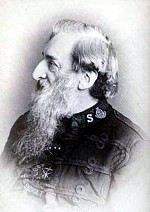
(2) Today in 1865 – William Booth began his ministry
Among the poor and disenfranchised of the city of London, General Booth began a service for Christ that would eventually spread around the world. The work at first was called simply The Christian Mission, but Booth later adopted the name known today, the Salvation Army. Innovative, and sometimes criticized for its methods, it has grown to be widely respected for a holy zeal that translates into a practical, shoe-leather kind of Christianity.
Though he wrote other songs, Boundless Salvation has been so identified with Booth that the Army labeled it “The Founder’s Song.” It is a soul-stirring celebration of God’s great salvation. As the book of Hebrews puts it, Christ has purchased for us “so great a salvation” and an “eternal salvation” (Heb. 2:3; 5:9). “He is also able to save to the uttermost [completely and forever] those who come to God through Him” (Heb. 7:25).
O boundless salvation! deep ocean of love, O fullness of mercy, Christ brought from above, The whole world redeeming, so rich and so free, Now flowing for all men, now flowing for all men, Now flowing for all men, come, roll over me!
The tide is now flowing, I’m touching the wave, I hear the loud call of the Mighty to Save; My faith’s growing bolder, delivered I’ll be; I plunge ’neath the waters, I plunge ’neath the waters, I plunge ’neath the waters they roll over me.
(3) We Bless Thee for Thy Peace, O God (Data Missing)
Here is a lovely hymn the authorship of which is unknown. It magnifies the peace of God in the heart of the believer, a peace that we can claim through prayerful trust in Him.
Be anxious for nothing, but in everything by prayer and supplication, with thanksgiving, let your requests be made known to God; and the peace of God, which surpasses all understanding, will guard your hearts and minds through CHrist Jesus (Phil. 4:6-7).
We bless Thee for Thy peace, O God, Deep as th’unfathomed sea, Which falls like sunshine on the road Of those who trust in Thee.
We ask not, Father, for repose Which comes from outward rest, If we may have through all life’s woes Thy peace within our breast.
That peace which suffers and is strong, Trusts where it cannot see, Deems not the trial-way too long, But leaves the end with Thee.
That peace which flows serene and deep, A river in the soul, Whose banks a living verdure keep, God’s sunshine o’er the whole.
O Father, give our hearts this peace, Whate’er the outward be, Till all life’s discipline shall cease, And we go home to Thee.
In 1831 Samuel Francis Smith’s patriotic hymn America (or My Country, ‘Tis of Thee) was first sung during an Independence Day Celebration of the Sunday School at Boston’s Park Street Church. Dr. Smith was an eminent clergyman, author and editor. He also taught modern languages in the college classroom.
The writing of the song came in a roundabout way. Hymn tune composer Lowell Mason returned from a visit to Germany with a number of German hymnals. Not being able to read the language, and knowing that his friend Samuel Smith could, Mason asked him to look them over and see if there was anything of use in them. In his examination of the books, Smith found a patriotic song using a tune that appealed to him.
Whether or not the tune is of British origin as some suppose, we do not know for sure. But for a long time it has been used for the British national anthem, God Save the Queen [or King]. Francis Smith dashed off some new American words on a scrap of paper with little thought that the song would soon be sung extensively. But it certainly has been.
In the song, after extolling the greatness of America, there’s a prayer that God will preserve the freedom enjoyed by its citizens. Smith said that the fact that the tune was used in both England and America was a “beautiful bond of union between the mother country and her daughter.” In 1887 Dr. Smith visited the Board of Trade in Chicago. While sitting in the gallery, he was pointed out to some of the members. Suddenly the trading on the floor ceased, and all joined in a rousing rendition of his song.
My country, ’tis of thee, Sweet land of liberty, Of thee I sing; Land where my fathers died, Land of the pilgrims’ pride, From every mountainside, Let freedom ring!
Our fathers’ God, to Thee, Author of liberty, To Thee we sing; Long may our land be bright With freedom’s holy light; Protect us by Thy might, Great God, our King.
If you can find it on YouTube, take a look at the newsreel clip from Easter Sunday of 1939, when African American singer Marian Anderson made history by singing My Country, ‘Tis of Thee before the Lincoln Memorial.
Considered to have one of the greatest voices of the twentieth century, Marian Anderson, with quiet dignity, broke many barrier’s down. She was the first black performer to sing at the Metropolitan Opera, and she even sang hymns before an audience in the Soviet Union, during a time of severe religious oppression there–though she had been forbidden to do so! Her interpreter refused to translate the words, but the audience knew what she was doing. They stormed to the foot of the stage, pleading for her to sing them more sacred songs!
(2) Today in 1840 – James McGranahan Born
James McGranahan had little formal education, but he showed a special talent for music early on. His gospel music career was launched by a tragedy. After the sudden death of songwriter Philip Bliss and his wife in a train accident (in 1876) their trunk was recovered from the burning wreckage. In it was perhaps the last song Bliss ever wrote, My Redeemer (I Will Sing of My Redeemer). James McGranahan supplied the tune for it.
After that, he became associated with Major Daniel W. Whittle in his evangelistic meetings on both sides of the Atlantic. He had a beautiful tenor voice, and pioneered in using men’s choirs in his meetings. McGranahan supplied the melodies for dozens of gospel songs, occasionally writing the words himself as well (as he did for the missionary hymn Go Ye Into All the World, and for Verily, Verily.)
The words “verily, verily” are found 25 times in John’s Gospel (King James Version), falling from the lips of Jesus. They translate a double amen in Greek and, coming at the beginning of a statement, give it special emphasis. Sometimes the phrase is translated “truly, truly,” or “most assuredly I say to you.” McGranahan’s song takes the Lord’s statement in John 6:47 as the basis for a clear proclamation of the gospel of grace: “Most assuredly [verily, verily], I say to you, he who believes in Me has everlasting life” (cf. Jn. 3:3; 5:24)
Oh, what a Saviour that He died for me! From condemnation He hath made me free; “He that believeth on the Son,” said He, “Hath everlasting life.”
“Verily, verily, I say unto you; Verily, verily,” message ever new! “He that believeth on the Son” ’tis true! “Hath everlasting life!”
All my iniquities on Him were laid, All my indebtedness by Him was paid; All who believe on Him, the Lord hath said, “Hath everlasting life.”
Mr. McGranahan also provided the tune for Horatius Bonar’s stirring hymn, Hallelujah for the Cross. It perhaps works better as a choral number, but a medium to large-sized congregation can handle it if they are used to parts singing.
The cross, it standeth fast— Hallelujah, hallelujah! Defying every blast— Hallelujah, hallelujah! The winds of hell have blown, The world its hate hath shown, Yet it is not overthrown— Hallelujah for the cross!
Hallelujah, hallelujah, Hallelujah for the cross; Hallelujah, hallelujah, It shall never suffer loss!
’Twas here the debt was paid— Hallelujah, hallelujah! Our sins on Jesus laid— Hallelujah, hallelujah! So round the cross we sing Of Christ, our offering, Of Christ, our living King— Hallelujah for the cross!
(3) Today in 1900 – Joseph Macaulay Born
Born in Ireland, Joseph Cordner Macaulay served on the faculty of Moody Bible Institute, in Chicago. He also pastored a church in Ontario, Canada, and was president of London College of Bible and Missions in that province. Dr. Macaulay wrote a number of books, as well as 25 hymn texts and 20 hymn tunes. In 1957 he authored the text for the hymn We Sing the Boundless Praise in his desire “to maintain the note of praise in modern evangelical hymnody.” The hymn was published in Hymns for the Living Church (Hope Publishing Company, 1974).
We sing the boundless praise of Him who reigns on high, And of His glorious Son, the Lamb who brought salvation nigh. Thine everlasting pow’r and majesty we sing, But with our songs of sov’reign grace we’ll make heav’n’s arches ring.
Elijah Taylor Cassel was a medical doctor, an active Christian layman, and a gifted song leader. Around 1909 he abandoned his medical career and entered full-time Christian ministry.
Some years before, the Baptist Young People’s Union had asked him to write a hymn that they could use as a national theme. The result was the gospel song Loyalty to Christ. Cassel’s wife Flora composed the strong martial music for it.
Steadfast loyalty to the Lord was demonstrated by godly King Josiah in the Old Testament. Of him we read, “He did what was right in the sight of the Lord, and walked in the ways of his father [i.e. his forefather] David; he did not turn aside to the right hand or to the left” (II Kgs. 22:2).
And consider how Peter and John testified before the Jewish Sanhedrin, when told not to tell others about Christ, “Whether it is right in the sight of God to listen to you more than to God, you judge. For we cannot but speak the things which we have seen and heard” (Acts 4:18, 19-20). The Cassels’ song is a call to that kind of commitment.
From over hill and plain there comes the signal strain, ‘Tis loyalty, loyalty, loyalty to Christ; Its music rolls along, the hills take up the song, Of loyalty, loyalty, yes, loyalty to Christ.
“On to victory! On to victory!” Cries our great Commander, “On!” We’ll move at His command, We’ll soon possess the land, Through loyalty, loyalty, Yes, loyalty to Christ.
Come, join our loyal throng, we’ll rout the giant wrong, ‘Tis loyalty, loyalty, loyalty to Christ; Where Satan’s banners float we’ll send the bugle note, Of loyalty, loyalty, yes, loyalty to Christ.
(2) Let Christian Faith and Hope Dispel (Data Missing)
The authorship of this encouraging hymn is unknown, but the writing must have predated 1781, when it was revised for publication. You can listen to the tune on the Cyber Hymnal.
The words reflect upon the certainty and security of salvation in Christ, as Paul describes it in Romans 8:31-39. Nothing in heaven or earth is able to separate the believer from the love of Christ.
Let Christian faith and hope dispel The fears of guilt and woe; The Lord Almighty is our Friend, And who can prove a foe?
The Saviour died, but rose again Triumphant from the grave: And pleads our cause at God’s right hand, Omnipotent to save.
Who then can e’er divide us more From Jesus and His love, Or break the sacred chain that binds The earth to heav’n above?
Let troubles rise, and terrors frown, And days of darkness fall; Through Him all dangers we’ll defy, And more than conquer all.
Nor death, nor life, nor earth, nor hell, Nor time’s destroying sway Can e’er efface us from His heart Or make His love decay.
Each future period that will bless As it has blessed the past; He loved us from the first of time, He loves us to the last.
Mary Elizabeth Byrne was an Irish author, researcher, and linguist. She contributed to such reference works as the Old and Mid-Irish Dictionary and the Dictionary of the Irish Language. In 1905, she translated into prose an old Irish poem from around the 8th century (Rob tu mo bhoile, a Comdi cride). The English translation was versified in 1912 by Eleanor Hull, and it became the hymn Be Thou My Vision.
The word “vision” is used in this case to mean not only something seen, but a goal to aspire to. The hymn expresses an all-encompassing life commitment such as we see in the Apostle Paul who confessed, “Not as though I have already attained, or am already perfected; but I press on, that I may lay hold of that for which Christ Jesus as laid hold of me” (Phil. 3:12). “For to me, to live is Christ, and to die is gain” (Phil. 1:21).
Be Thou my Vision, O Lord of my heart; Naught be all else to me, save that Thou art. Thou my best thought, by day or by night, Waking or sleeping, Thy presence my light.
Be Thou my Battle Shield, Sword for the fight; Be Thou my Dignity, Thou my Delight; Thou my soul’s Shelter, Thou my high Tower: Raise Thou me heavenward, O Power of my power.
Riches I heed not, nor man’s empty praise, Thou mine Inheritance, now and always: Thou and Thou only, first in my heart, High King of heaven, my Treasure Thou art.
(2) Come, Holy Spirit, Calm My Mind (Data Missing)
Here is a lovely little prayer hymn of unknown origin. (You can hear the tune on the Cyber Hymnal.)
How often have we prayed from a barren sense of duty, or else rushed into the presence of God, with anything and everything on our minds except communing with our heavenly Father? Here is a prayer for such times.
Come, Holy Spirit, calm my mind, And fit me to approach my God; Remove each vain, each worldly thought, And lead me to Thy blest abode.
Hast Thou imparted to my soul A living spark of heavenly fire? O kindle now the sacred flame; Teach it to burn with pure desire.
Impress upon my wandering mind The love that Christ for sinners bore; And give a new, a contrite heart, A heart the Saviour to adore.
A brighter faith and hope impart, And let me now the Saviour see; O soothe and cheer my burdened heart, And bid my spirit rest in Thee.
Mrs. Stowe was a person of many accomplishments, especially considering the limitations often placed on women in the nineteen century. Daughter of a Congregational clergyman named Lyman Beecher, and sister of another, Henry Ward Beecher, she married a seminary professor, and taught at a college herself. She authored the best-selling anti-slavery novel Uncle Tom’s Cabin in 1852, and wrote more than 40 other books.
It was at the request of her brother that Harriet Stowe created the beautiful morning hymn, Still, Still with Thee. It is said the author habitually rose at 4:30 each morning, going for walks in the quiet dawning to ponder the things of God.
The hymn seems to be a meditation on Psalm 139:18, “When I awake, I am still with You.” The Lord promised believers on this side of the cross that we will have His continuing presence with us (Matt. 28:20). And in eternity it is His desire “that where I am, there you may be also” (Jn. 14:3).
For this song, most hymn books use the tune Consolation, based on a melody by Felix Mendelssohn. But try singing it to Joseph Barnby’s lovely tune Alverstoke and you may never go back to the other. (Alverstoke is one of the alternate tunes for the hymn you can listen to on the Cyber Hymnal.)
Still, still with Thee, when purple morning breaketh, When the bird waketh, and the shadows flee; Fairer than morning, lovelier than daylight, Dawns the sweet consciousness, I am with Thee.
So shall it be at last, in that bright morning, When the soul waketh and life’s shadows flee; O in that hour, fairer than daylight dawning, Shall rise the glorious thought, I am with Thee.
(2) Today in 1942 – Andrae Crouch Born
Crouch’s career has included being a singer, songwriter, music producer, and pastor. His best-known gospel songs are: The Blood Will Never Lose Its Power, Through It All, and My Tribute.
To God be the glory, to God be the glory, To God be the glory for the things He has done. With His blood He has saved me; With His pow’r He has raised me. To God be the glory for the things He has done.
Though his songs have some merit, Andrae Crouch has been instrumental in blurring the important distinction between sacred and secular music. He has worked as a producer and arranger for Michael Jackson, Madonna, and Elton John, and he became only the third gospel musician to have his star enshrined on the Hollywood Walk of Fame. To be so linked with those who are demonstrably morally corrupt is to my mind a violation of God’s call to separation (II Cor. 6:14–7:1).
Hopkins was an English church organist (for 55 years in one church alone!). He was given an honorary doctorate by the Archbishop of Canterbury. A recognized authority in his field, Edward John Hopkins wrote a book called The Organ: Its History and Construction. Hopkins wrote a variety of church music and was respected as an editor of hymnals. He produced many hymn tunes, but only one remains in common use in America–his tune Ellers, for the hymn Saviour Again, to Thy Dear Name We Raise.
The text for this lovely closing hymn was written by John Ellerton in 1866. The last line of the third stanza quoted below is taken from Psalm 139:12, “The darkness and the light are both alike to You.” Or, as the New American Standard Bible has it, “Even the darkness is not dark to You.” None of the circumstances we face, day by day, is hidden from God. He sees and knows all about what may seem obscure and threatening to us.
Two of our biggest problems with the darkness are: we’re not sure where we are going, or which way to go; and we’re not sure what’s “out there,” causing us to be anxious about unknown dangers. But our assurance is that the darkness is no different than the light to the Lord. He will continue to lead His children, holding us in the hollow of His hand, whether the way be dark or light.
Saviour, again to Thy dear name we raise With one accord our parting hymn of praise; We stand to bless Thee ere our worship cease; Then, lowly kneeling, wait Thy word of peace.
Grant us Thy peace upon our homeward way; With Thee began, with Thee shall end the day. Guard thou the lips from sin, the hearts from shame, That in this house have called upon Thy name.
Grant us Thy peace, Lord, through the coming night; Turn Thou for us its darkness into light; From harm and danger keep Thy children free, For dark and light are both alike to Thee.
Edward Hopkins also wrote the tune for the children’s hymn The Wise May Bring Their Learning. (The hymn tune is called Christmas Morn.) There are some good things in the text, and it would be well for it to be given a wider use than it has at present.
The wise may bring their learning, the rich may bring their wealth, And some may bring their greatness, and some bring strength and health; We, too, would bring our treasures to offer to the King; We have no wealth or learning; what shall we children bring?
We’ll bring Him hearts that love Him; we’ll bring Him thankful praise, And young souls meekly striving to walk in holy ways; And these shall be the treasures we offer to the King, And these are gifts that even the poorest child may bring.
We’ll bring the little duties we have to do each day; We’ll try our best to please Him, at home, at school, at play; And better are these treasures to offer to our King; Than richest gifts without them—yet these a child may bring.
In spite of the recent turn to overhead projectors and video projectors, I believe there is still a place for hymnals in the pews. If you are contemplating the purchase, check out Choosing a Hymn Book for Your Church.
John Henry Wilcox was an American church organist who died at the relatively young age of 49. He is known in hymn history for one small contribution. He wrote the tune Faben, that is often used with a couple of hymns: Praise the Lord, Ye Heavens Adore Him, and Lord, with Glowing Heart I’d Praise Thee.
Both of these are hymns of praise to God. And some form of the word “praise” is found over 250 times in our English Bibles. We see it first when Jacob’s wife Leah praises the Lord for the birth of Judah (Gen. 29:35). And in John’s vision of the eternal heavenly city we read of a command that will issue from the throne of God, “Praise our God, all you His servants and those who fear Him both small and great” (Rev. 19:5).
Over 150 times in the book of Psalms alone we read of praising God. This suggests a dominant theme of the book. David the psalmist declares, “I will be glad and rejoice in You; I will sing praise to Your name, O Most High” (Ps. 9:2). Because of the greatness of our God, He is utterly deserving of all the praise we can render to Him. “The Lord…is worthy to be praised” (Ps. 18:2). In the words of Francis Scott Key’s 1819 hymn,
Lord, with glowing heart I’d praise Thee, For the bliss Thy love bestows, For the pardoning grace that saves me, And the peace that from it flows: Help, O God, my weak endeavour; This dull soul to rapture raise: Thou must light the flame, or never Can my love be warmed to praise.
(2) Gracious Father, Guard Thy Children (Data Missing)
This is a thoughtful hymn expressing a prayer for God’s protection in a time of trial. The author is unknown. You can hear the tune on the Cyber Hymnal.
Gracious Father, guard Thy children From the foe’s destructive power; Save, O save them, Lord, from falling In this dark and trying hour. Thou wilt surely prove Thy people, All our graces must be tried; But Thy Word illumes our pathway, And in God we still confide.
We are in the time of waiting; Soon we shall behold our Lord, Wafted far away from sorrow, To receive our rich reward. Keep us, Lord, till Thine appearing, Pure, unspotted, from the world; Let Thy Holy Spirit cheer us Till Thy banner is unfurled.
With what joyful exultation Shall the saints Thy banner see, When the Lord for whom we’ve waited Shall proclaim the jubilee! Freedom from this world’s pollutions; Freedom from all sin and pain; Freedom from the wiles of Satan, And from death’s destructive reign.